

Updated: September 10th, 2026 | Published: August 14th, 2025
5 min. read
Interested in joining PartnerMD? Click below to talk to a member of our team.

If you’re considering concierge medicine, choosing the right doctor is one of the most important decisions you’ll make.
But not every concierge doctor provides the same experience or approach to care.
Finding the right fit means looking beyond the concierge label. You’re choosing a physician, but the practice and team supporting that physician will also shape your experience.
One of the most important things to consider is whether that experience will give you greater confidence in your care. In PartnerMD’s 2026 State of Primary Care Report, only 14% of respondents said they felt very confident they were getting the best possible care.
At PartnerMD, we’ve helped thousands of patients navigate this decision over the last 20 years. The right concierge doctor should offer more than easier access to primary care. As you compare physicians, keep these key points in mind:
- Experience should fit your needs. Look for a physician with the background and expertise to support your individual health needs.
- Their approach should align with your goals. Consider whether their philosophy of care matches what you want from your healthcare.
- Access should be clearly defined. Know what kind of access and responsiveness you can realistically expect.
- Time matters. Make sure the physician has the time and availability to provide the level of attention you’re looking for.
- Prevention should be proactive and personalized. Look for a physician who focuses on your individual risks and long-term health.
- Care should extend beyond the exam room. Consider how involved your physician will be when you need care from other providers.
- The concierge model should make a meaningful difference. Look beyond the list of benefits to understand how the model actually changes the care the physician can provide.
With those priorities in mind, here are seven questions to ask when choosing the right concierge doctor.

1. What experience do you have with patients with health needs like mine?
A strong relationship with your concierge doctor starts with trust, and part of that comes from knowing they have the right experience for your health needs.
Start with the basics. Is the physician board-certified? What is their medical background, and how long have they been practicing? Then consider experience that is particularly relevant to you, such as
- Conditions or health concerns that are important to you
- Experience caring for patients with similar medical histories or needs
- Areas of clinical interest or additional training relevant to your care
- Experience managing complex health needs
Look for experience that is relevant to your health needs, not simply the number of years a physician has practiced. Credentials matter, but relevance matters just as much.
2. What is your approach to care?
Every concierge physician has a slightly different approach. Some focus heavily on prevention and early detection. Others may have more experience managing complex or chronic conditions or place greater emphasis on lifestyle, healthy aging, and long-term health.
Think about what you want from your relationship with your doctor. Are you looking to stay ahead of future health risks? Manage an ongoing condition? Improve your overall health as you age?
Ask how the physician works with patients who have goals similar to yours. Listen for whether they talk about your goals, not just the conditions they treat. Their answer can help you determine whether their philosophy of care aligns with what you want from your healthcare.

3. What kind of access can I expect?
Better access is one of the main reasons people consider concierge medicine, but what that means can vary by physician and practice.
Ask how you can reach your doctor when you have a question or concern. Can you contact them directly by phone, text, email, or a patient portal? Does the practice provide 24/7 access when you need care after hours? Who responds if your physician is unavailable?
Same-day or next-day appointments are common in concierge medicine, particularly when an immediate need arises. Ask whether that is the practice’s typical standard and how quickly you can expect a response when you have a question or concern.
4. How long are appointments, and how many patients do you see?
Having enough time with your physician can shape the entire experience of a visit. In PartnerMD’s 2026 State of Primary Care Report, 68% of respondents said their visits feel rushed sometimes or always.
When choosing a concierge doctor, it’s worth understanding how much time you can expect to have and whether the physician’s practice is structured to provide it.
Ask how long typical appointments are and whether more time is available when needed. Longer visits can create space to discuss the immediate concern along with questions, changes in your health, and issues that might otherwise get pushed to another visit.
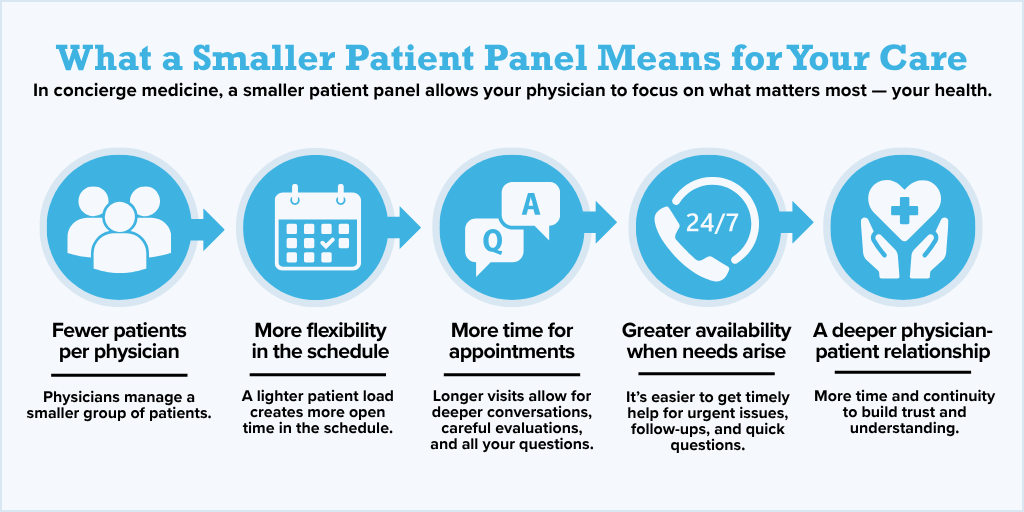
Patient panel size is important, too. Caring for fewer patients can give a physician more flexibility for longer appointments, urgent needs, and getting to know each patient.
As a rule of thumb, concierge physicians often care for several hundred patients rather than the 1,500–2,500 or more patients common in traditional primary care. A panel of roughly 300–600 patients can be a useful benchmark, although there is no single “right” number.
More important than the number itself is what it allows the physician to provide. Ask whether their panel size supports longer appointments, timely access, and the level of personal attention you expect from concierge care.
5. What preventive care and wellness support do you provide?
Concierge medicine can create more opportunities to be proactive about your health, but the level of preventive care and wellness support varies by physician and practice.
Ask how the physician identifies health risks and personalizes preventive care based on your age, medical history, family history, and goals. This may include comprehensive annual physicals, appropriate diagnostic testing, and screenings based on your individual risk factors.
Also consider what support is available between visits. Some concierge practices offer health coaching for nutrition, exercise, sleep, stress, and other lifestyle factors.
Listen for whether prevention is an ongoing part of care or something primarily addressed at the annual physical. Ask how the physician follows up on health risks, screening results, and goals throughout the year, and what support is available between visits.
6. How involved are you when I need a specialist or other care?
Even with a great concierge doctor, there will be times when you need a specialist, imaging, additional testing, or hospital care.
Ask what role the physician plays when that happens. Do they help identify the right specialist, assist with scheduling, and share relevant medical records? Will they review results and recommendations with you afterward and help you understand what comes next?
This becomes especially important when multiple providers are involved. Your concierge physician should understand the bigger picture and make sure important information doesn’t get lost between providers.
A referral alone isn’t necessarily care coordination. Look for a physician and practice that stay involved after the referral, helping connect information between providers and keeping track of what happens next.
7. What does being a concierge doctor allow you to do differently for your patients?
Listen for more than a list of benefits. Does having fewer patients allow the physician to know them more personally? Does more time make it possible to dig deeper into concerns or follow up more closely? Does better access help them address problems sooner?
Pay attention to how the physician talks about the practice around them, too. You’re choosing a doctor, but you’re also joining a concierge practice. The team and systems supporting the physician contribute to your experience, from scheduling and communication to care coordination and follow-through.
Concierge medicine should feel different in the way your care is delivered, not simply in the benefits listed on a website. The physician’s answer can tell you a lot about what being their patient will actually be like.
FAQs About Choosing a Concierge Doctor
Should I meet a concierge doctor before choosing one?
Yes. A conversation with a prospective physician can help you understand their approach to care, communication style, experience, and what you can expect as a patient. It also gives you an opportunity to ask the questions that matter most to your health and determine whether the relationship feels like a good fit.
How do I know if a concierge doctor is right for me?
Look for a physician whose experience and approach align with your health needs and who provides the access, time, preventive focus, and care coordination you expect. Just as importantly, you should feel confident in the physician and the practice supporting them.
Do all concierge doctors offer the same services?
No. Concierge practices can differ in appointment length, physician access, annual physicals, preventive services, wellness support, care coordination, and what is included in the membership fee. Ask for specifics so you can make an accurate comparison rather than assuming all concierge medicine works the same way.
Ready to find the right concierge physician?
Choosing a concierge doctor is about more than finding a physician who offers membership-based care. It’s about finding someone with the right experience, approach, and level of involvement for your health, supported by a practice that can consistently deliver the kind of care you expect.
At PartnerMD, our physicians have the time to build meaningful relationships with their patients, focus on prevention and long-term health, and stay involved when care extends beyond our offices. They’re supported by a team designed around the same personalized, responsive approach.
If you’re looking for a concierge physician who can provide that kind of relationship and support, complete our form to schedule a conversation with a PartnerMD team member. We can answer your questions, explain how membership works, and help you find the right physician for your needs.
Topics:
