

September 15th, 2026
5 min. read
By Bonnie Reeves, Chief Practice Officer
Wondering if your primary care is working for you? Take the 3-minute check-up to get your personalized care score.
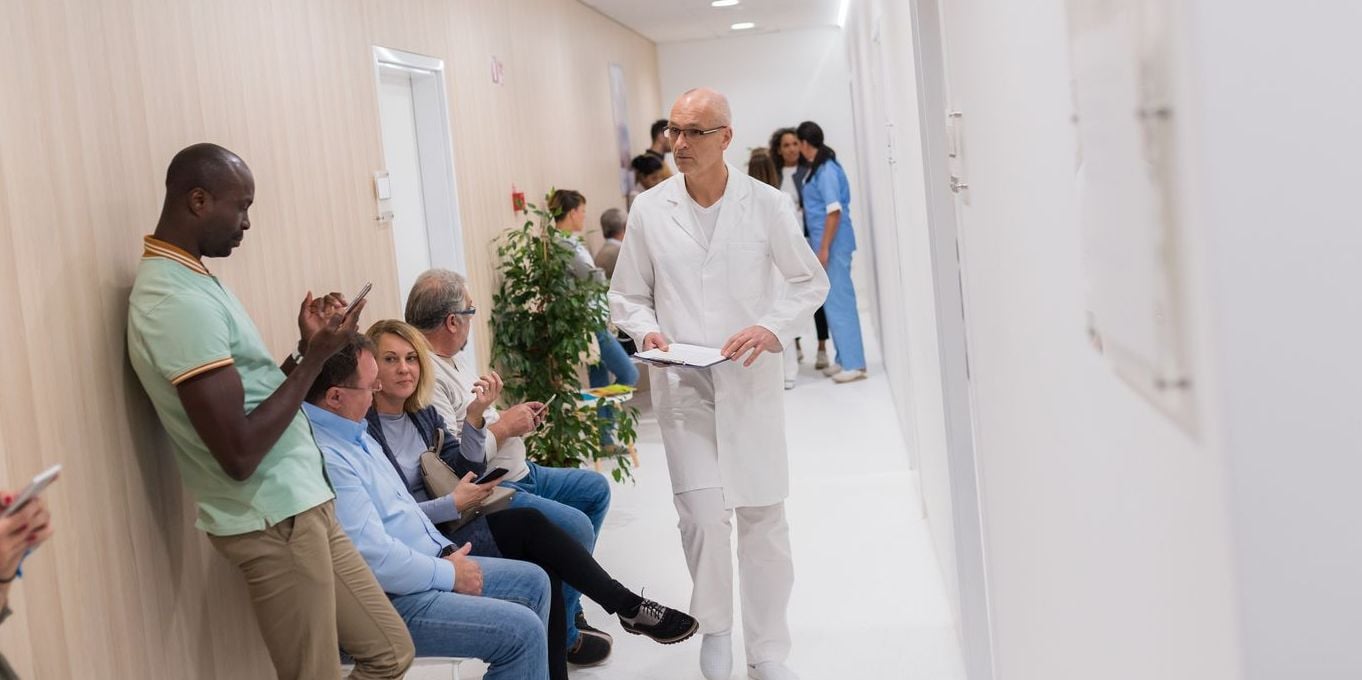
How many patients does your primary care doctor care for?
Most people don't know. But that number may have more to do with your primary care experience than you realize.
It can influence how long you wait for an appointment, how much time your doctor can spend with you, how well they know your medical history, and how much capacity they have to focus on prevention, follow-up, and the bigger picture of your health.
That number is known as a physician's patient panel. And in traditional primary care, it can number in the thousands.
The challenge becomes clearer when you look at the math. A 2022 study published in the Journal of General Internal Medicine estimated that a primary care physician would need 26.7 hours every day to provide all recommended acute, chronic, and preventive care to a typical panel.
There simply aren't enough hours in the day.
At PartnerMD, we've spent more than 20 years working within a different model of primary care, built around intentionally smaller patient panels. Here's why panel size matters and what can change when physicians have more capacity for each patient.
A few things are important to understand about patient panel size:
- A patient panel is the total number of patients a physician is responsible for providing ongoing care to.
- Traditional primary care physicians may be responsible for 2,000 or more patients.
- Larger panels can put pressure on appointment availability and physician time, both during visits and between them.
- Smaller panels create more capacity per patient, making more time, greater access, continuity, follow-up, and a stronger focus on prevention possible.
- Patient panel sizes vary even among concierge practices, making it an important question to ask when choosing a physician.
/iStock-1459452082-modified-f05a0a8c-259a-42bc-be22-d0d72f6af3f1.jpg?width=1254&height=626&name=iStock-1459452082-modified-f05a0a8c-259a-42bc-be22-d0d72f6af3f1.jpg)
How Many Patients Does a Primary Care Doctor Care For?
Traditional primary care physicians can care for around 2,000 patients. An analysis of American Board of Family Medicine data found that U.S. family physicians who reported their patient panel size cared for an average of 1,933 patients.
The number a physician can reasonably care for depends on factors such as patient complexity, available clinical support, physician schedule, and how the practice is structured. And caring for a panel involves much more than seeing patients in the exam room.
Each patient can generate lab and imaging results, prescription refills, portal messages, referrals, specialist reports, documentation, follow-up, and preventive care needs.
A patient panel isn't simply a number. It represents thousands of ongoing healthcare needs and relationships that a physician and their team are responsible for managing.
Why Are Primary Care Patient Panels So Large?
Large patient panels aren't simply a matter of physicians choosing to see more patients.
Traditional primary care has historically operated on a volume-based model in which practices depend heavily on reimbursement for individual patient visits. At the same time, there are fewer primary care physicians available to meet growing demand. According to the Association of American Medical Colleges (AAMC), the United States could face a shortage of up to 40,400 primary care physicians by 2036.
That shortage comes as the population is aging and more Americans are living with chronic conditions, increasing the need for preventive care, chronic disease management, and routine medical visits.
Physicians are also being asked to do more for every patient, from preventive screenings and chronic disease management to electronic documentation, patient messages, medication management, and care coordination.
The result is a difficult capacity problem: more patients needing care, fewer available primary care physicians, more to manage for each patient, and only so many hours in a day.
But traditional primary care isn't the only choice.
Is There Another Option for Primary Care?
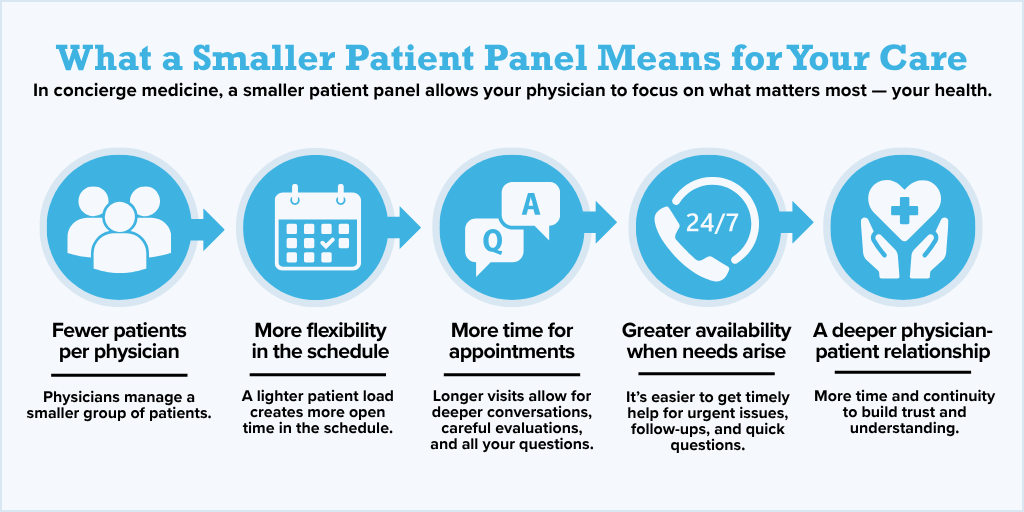
For patients looking for more time and access to their physician, concierge medicine offers a different model built around smaller patient panels. By using a membership fee to support the practice, concierge physicians can care for significantly fewer patients, creating more capacity for timely appointments, longer visits, continuity, prevention, and follow-up.
Panel sizes vary by concierge practice, so it's important to understand what a particular practice offers.
Here's what that additional capacity can make possible.
More Access and More Time
Two of the most noticeable differences can be appointment availability and time with your physician.
PartnerMD's 2026 State of Primary Care Report, based on responses from more than 500 people about their primary care experiences, found that 62% wait at least a week to see their doctor or don't have a regular primary care physician.
Time during the appointment can be limited, too. 68% said their appointments feel rushed sometimes or always.
Smaller patient panels give concierge physicians more flexibility to maintain room in their schedules for patients who need care quickly and to spend more time with patients once they're there.
Greater Continuity With Your Physician
Smaller panels also create more opportunity to build a relationship with the same physician over time.
That continuity has value beyond convenience. A 2025 systematic review published in the British Journal of General Practice examined 18 studies on continuity between patients and their primary care physicians. Researchers found that higher continuity was associated with lower risks of premature mortality, hospital admission, and emergency department visits.
A smaller panel doesn't guarantee those outcomes. But it can give physicians more opportunity to become familiar with a patient's history, priorities, and changes in their health over time.
More Capacity for Prevention and Follow-Up
Smaller patient panels can also create more time for the work that goes beyond addressing an immediate health concern.
Prevention takes time. So does reviewing results, answering questions, coordinating with specialists, managing referrals, and following up after an appointment.
And patients appear to notice when that capacity is missing. In the State of Primary Care Report, 80% of respondents said they worry an important health issue could slip through the cracks with their current care.
Reducing the number of patients a physician is responsible for creates more capacity for both sides of primary care: what happens when you're in the exam room and what needs to happen after you leave.
What Does a Smaller Patient Panel Look Like at PartnerMD?
PartnerMD was designed around this idea more than 20 years ago.
Our physicians care for no more than 450 patients and typically see about six to 10 patients per day. That smaller panel helps make it possible to offer 30-minute appointments, same- or next-day acute care, up to 90 minutes with your physician during a comprehensive physical, and an ongoing relationship with a dedicated physician.
When Time and Familiarity Matter
For PartnerMD member Michael Levy, the value of having a physician who knows his health and has time to look closely became particularly meaningful after knee surgery.
Michael has been a PartnerMD patient for nearly a decade and now sees Dr. Jordan Jackson at PartnerMD Midlothian, where he has built trust in his physician over time.
Following Michael's knee surgery and a subsequent hospitalization, Dr. Jackson reviewed what had happened and closely examined significant swelling in his leg. He ordered a same-day ultrasound to make sure a blood clot had been ruled out.
The ultrasound found a blood clot.
For Michael, the experience reinforced the value of having a physician with the time and familiarity to look closely at the full picture.
“It's not an exaggeration to say he may have saved my life.”
Patient Panel Size Is Worth Asking About
Not every concierge medicine practice has the same patient panel size. If you're considering concierge care, don't assume the word "concierge" tells you how much access or physician time you'll actually receive.
Ask:
- How many patients does each physician care for?
- How long are typical appointments?
- Will I consistently see my own physician?
- How quickly can I get an appointment when I'm sick?
- How much time does my physician spend with me during my annual physical?
- Who follows up on testing, referrals, and specialist care?
The answers can tell you much more about the primary care experience you're likely to receive than the concierge label alone.
Not sure how your current primary care measures up? Start with our free PartnerMD Primary Care Check-Up.
In just a few minutes, you'll answer questions about many of the same things we've covered here, including access to care, time with your physician, and preventive support. Your results will show where your current care is working well and where there may be opportunities to improve.
At PartnerMD, limiting each physician's panel to 450 patients is fundamental to how our model was designed. It creates more capacity for each patient: more availability when you need care, more time when you're together, and more opportunity for your physician to know you and your health over time.

Topics:
